
Basement Dehumidifier Systems in Kirksville, MO
Removing the humidity that drainage alone leaves behind.
Get a Free EstimateWaterproofing removes liquid water. It does not remove humidity. Concrete, block, and the soil beyond them keep releasing moisture as vapor, and in a below-grade space with little air movement that vapor has nowhere to go. This is why a basement can be free of visible water and still smell musty, feel clammy, and rust anything metal stored in it.
Controlled humidity is the last step in a complete moisture plan. Held at a reasonable relative humidity, a basement no longer supports mold and mildew growth, which protects both the air quality of the whole house and the structural wood down there, including floor joists, subfloor, and sill plates. It also protects what you keep in the space, from stored boxes and furniture to tools and mechanical equipment.
A consumer dehumidifier from a home center is built for a bedroom, not a basement. Its capacity is small, its coils are not designed to keep working at cooler below-grade temperatures, and it needs its tank emptied by hand. Basements are exactly where those units fail: they run continuously, ice up in cool weather, and fall behind the moisture load within a season or two.
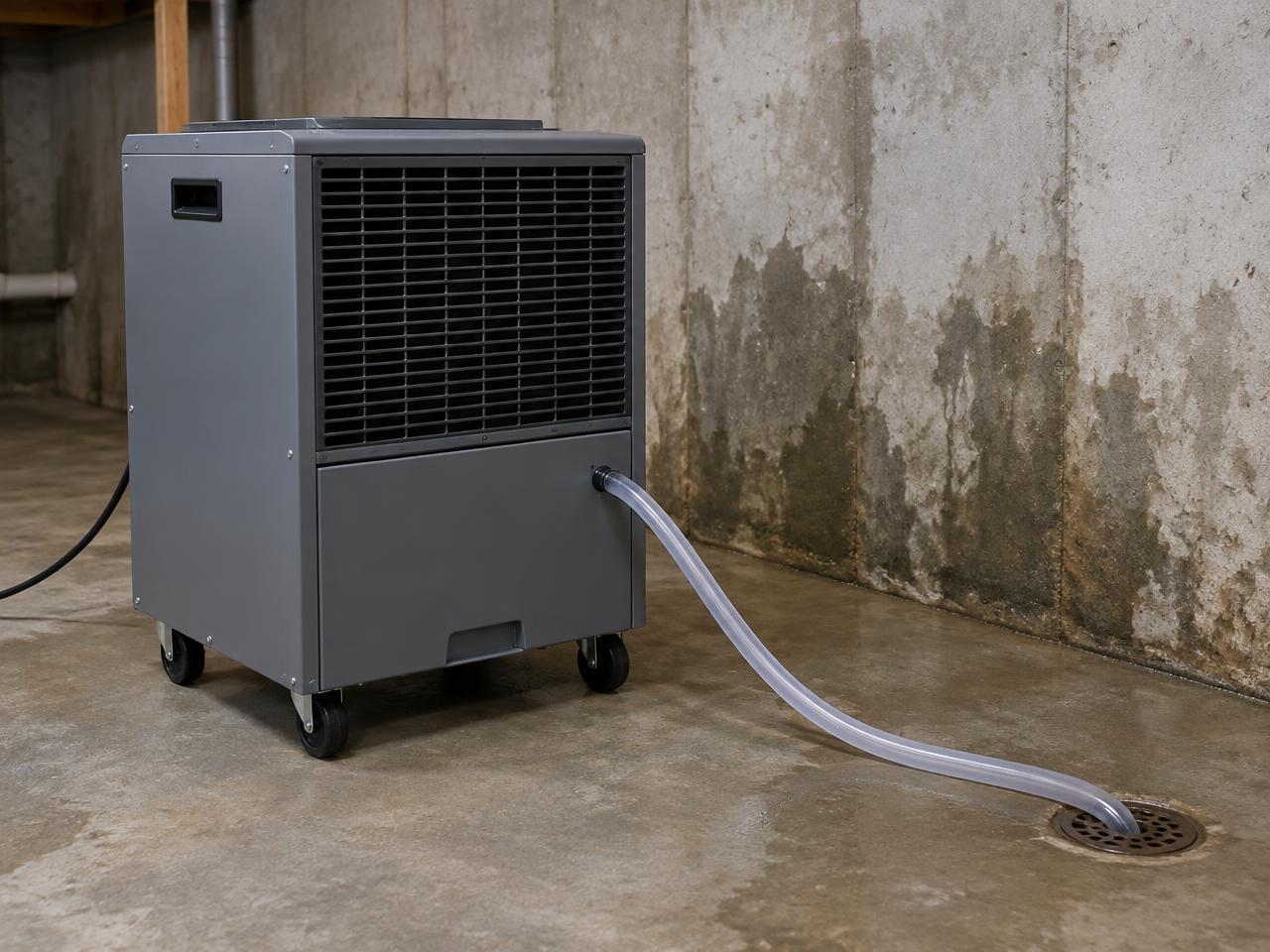
Commercial-grade basement dehumidifiers are a different class of equipment. They move far more air, remove several times the water per day, operate efficiently at basement temperatures, drain continuously by hose to a sump or floor drain rather than into a tank, and run on a humidity setpoint so they cycle only as needed. They are built to run for years in the conditions where consumer units burn out.
Foundation Restoration sizes the unit to the volume of the space and the moisture load we measure, places it where airflow will actually reach the whole basement or crawl space, and sets up the condensate drain so nobody has to empty anything. We install dehumidification as the finishing component of interior waterproofing, vapor barrier, and crawl space work.
What Is Included
- Removes residual humidity after waterproofing
- Suppresses conditions for mold and mildew growth
- Protects floor joists, subfloor, and stored belongings
- Commercial grade capacity that works at basement temperatures
- Continuous condensate drainage with no tank to empty
Frequently Asked Questions
Somewhere in the range of 45 to 55 percent relative humidity is the practical target. That is dry enough to stop mold growth and musty odor without over-drying the space, and a dehumidifier with a humidistat holds it there automatically.
No. A dehumidifier handles vapor, not liquid water entering through walls or floor. If water is coming in, it needs drainage and waterproofing first, and the dehumidifier then controls what remains in the air.
It needs somewhere for the condensate to go, which is usually a hose run to the sump pit or an existing floor drain. We set that up during installation so the unit drains continuously without anyone emptying a tank.
Get a Free Dehumidifier Estimate
Call us at 573-418-1936 or request a free estimate and we will come out, assess your situation, and give you an honest answer.